Welcome to October! By now you’ve spent the first month getting to know your students, building classroom routines, and learning who needs what. And through all of that, you’ve realized you have a LOT of different learners. Like, a LOT.
You have students who:
- finish in three minutes
- need constant support
- struggle to read directions
- are English learners
- have IEP accommodations
- learn best by talking
- learn best by drawing
And they’re all in the same classroom. And somehow, you’re expected to help every one of them succeed.
Ask around for advice, and you might hear “just differentiate.” It sounds overwhelming. Many teachers assume that to differentiate instruction, they have to create five different lessons. But the good news? That’s not what differentiation actually means. You don’t need five different lesson plans. You need one lesson with multiple ways for students to access and show learning.
Let’s get into it.
What Does Differentiation Actually Mean?
Differentiation is a method of designing and delivering instruction to best reach each learner. Teachers might differentiate content, process, products, and/or the learning environment, with the use of ongoing assessment and flexible grouping (Tomlinson, 2014)
Basically, instead of changing what students are learning, we are changing how a student is learning it.
We change:
- how they access information
- how much support they receive
- how they practice
- how they demonstrate understanding
Everyone is working toward the same learning goal; they’re just taking different paths to get there.
Here’s how that looks in a real classroom.
Strategy 1: How to Differentiate Instruction with One Lesson
This is probably the biggest mindset shift. Don’t build five lessons. Build one.
Ask yourself:
“What is the ONE thing every student absolutely needs to learn today?”
Everything else is flexible.
For example, your learning objective is that by the end of the lesson, your students will be able to identify the main idea.
Now, don’t change the lesson objective; change the supports.
Some students can:
- listen to the passage
- read independently
- work with a partner
- use a graphic organizer
- receive sentence starters
It’s the same lesson but with different supports. Do you see how we did that? They’re all working toward the same learning target – they simply have different supports along the way. Lesson objective met.
Strategy 2: Create Multiple Entry Points for Learning
You will have students on many different levels. But students don’t all need to start in the same place. Your base lesson will be the same for all, but you can create different places for your students to start.
For example, your beginning learners can begin with picture supports and vocabulary preview.
Your grade-level learners can do the standard activity.
Your advanced learners can do an extension question, a deeper discussion, or a real-world application.
Think of differentiation as multiple ways to get to the same destination. Some students need ramps, some need stairs, and some take the elevator.
Strategy 3: Use Flexible Grouping to Differentiate Instruction
Groups shouldn’t stay the same all year.
Mix it up.
Sometimes group by:
- readiness
- interest
- learning style
- random partnerships
- teacher support
If students are changing groups all the time, they are less likely to label or be labeled. They can find success with multiple partnerships. In one grouping, they can be with students with similar learning styles. In another grouping, they can benefit from peer modeling. This gives some students opportunities to learn from their peers and other students the opportunity to reinforce their learning by modeling for their group mates.
Strategy 4: Let Students Choose Their Learning Pathway
As teachers, we like engaged students. Engaged students are happier and learn more. Choice increases engagement without creating extra work.
Think about a boring professional development you’ve attended recently. Maybe it was an expert lecturing at the front of the room with slides. Did you think to yourself, “I wish this was just an article I could read instead” or “Can’t I just discuss with a colleague instead?”
That’s how our students feel too.
Again, this doesn’t mean creating different lessons for students to access. It can be as simple as creating a choice board.
Introduce the lesson, and then students choose how they demonstrate their learning. They can:
- write
- draw
- create
- record
- teach a partner
Choice doesn’t mean lowering expectations. It means allowing different ways to demonstrate learning.
Your artistic student can create a poster. Your below-level reader can create a graphic novel. Your tech-loving student can create a podcast episode. Think of all the ways your students can engage with the same task in a way that they love. Much more impactful than listening to you talk!
Strategy 5: Differentiate Instruction Through Questions
Another easy way to differentiate instruction is through the questions you ask. I often do this in my classroom when I have students grouped together that may be at different learning speeds.
For example, we will read a story out loud together. However, as we go along, I will ask different students different questions.
Student A
“What happened first?”
Student B
“Why do you think the character made that decision?”
Student C
“What evidence supports your thinking?”
Notice that these questions move from simple recall to deeper critical thinking. You can easily adjust questioning based on where each student is while keeping everyone engaged in the same lesson.
Strategy 6: Make Exit Tickets Work for Everyone
Exit tickets are a great tool for assessing student learning. However, one identical exit ticket doesn’t work for each student.
Instead, offer options.
Students can:
✔ write
✔ draw
✔ verbally explain
✔ sort cards
✔ answer multiple choice
✔ complete a sentence stem
You still get formative assessment, but students show their understanding differently.
Common Differentiation Mistakes
While the intention is often there for teachers, the execution can sometimes need a little work. Teachers can spend a lot of our very precious time overplanning.
Here are some things to avoid:
❌ Making separate worksheets for every child
❌ Grouping students permanently
❌ Lowering expectations
❌ Giving “extra work” to advanced learners
❌ Giving every struggling learner easier work
❌ Assuming accommodations = differentiation
Remember This
We are all busy, overworked, and underappreciated. The last thing we want to do is make more work for ourselves. But think about your students. Think about how much more meaningful your lessons will be if they can access them in a way that is successful for them.
Differentiation isn’t about making learning easier. It’s about making learning accessible. It’s one lesson, one learning goal, but multiple pathways to get there. When students feel successful, they participate more, take more risks, and begin believing they can learn. That’s what great differentiation really creates.
Free Differentiation Planning Template
Does everything you read here sound good in theory but hard in practice? We get that! That’s why we’ve created a 5-Minute Differentiation Planner to make lesson planning easier. As you get more comfortable, you won’t need the planner, but it’s a great way to get started.
The printable will help you quickly think through:
- Learning target
- Possible supports
- Multiple entry points
- Flexible grouping ideas
- Choice options
- Exit ticket ideas
Instead of reinventing the wheel every lesson, you can spend just a few minutes planning intentional supports that work for all learners.
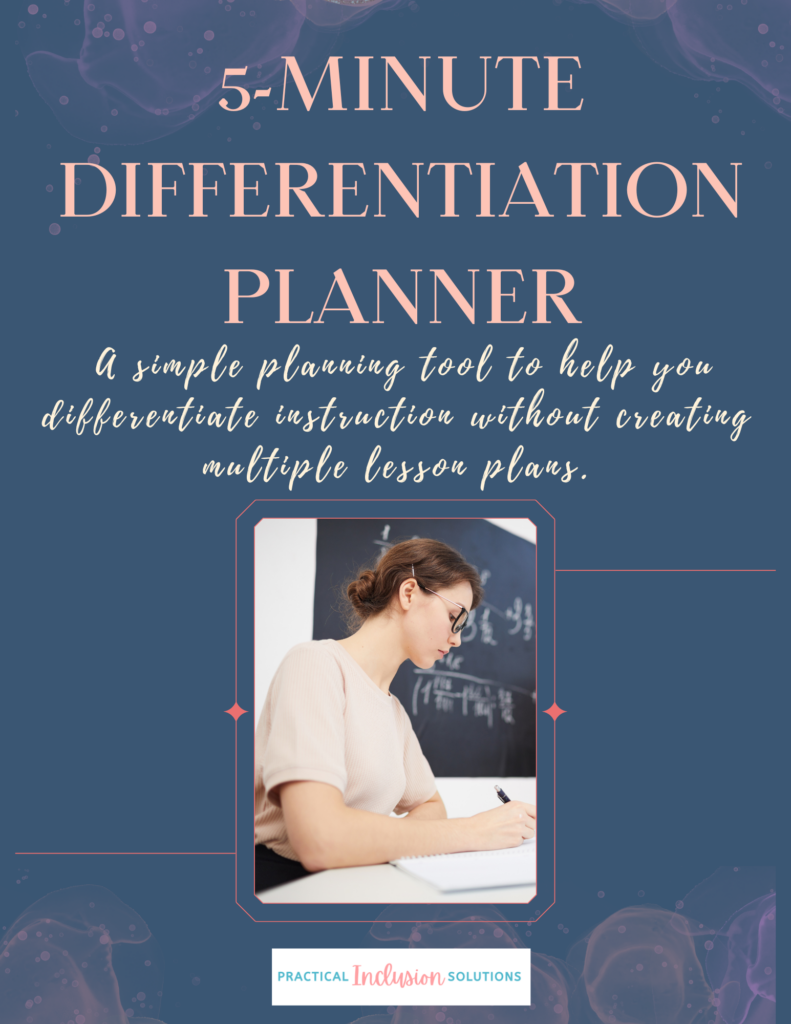
Download the free planning template and make differentiation feel manageable—not overwhelming.
Conclusion
If you’ve ever believed differentiation meant creating multiple lesson plans every day, you’re not alone. Many teachers feel that pressure.
Learning how to differentiate instruction doesn’t have to mean doing more work. The truth is, effective differentiation isn’t about doing more—it’s about planning smarter. A few intentional supports can make one lesson accessible to a classroom full of diverse learners.
Start with one strategy this week. You don’t have to become an expert overnight. Small, intentional changes often have the biggest impact. As you build your confidence, you’ll discover that differentiation becomes less about extra work and more about giving every student a meaningful opportunity to succeed.
Good luck, and let us know how it goes!!
One Reply to “How Do I Differentiate Instruction Without Creating Five Lesson Plans?”