Picture this. You read through your students’ IEPs. You get to the classroom accommodations page and see things like:
- Preferential seating
- Chunk assignments
- Frequent check-ins
- Visual supports
- Extended time
- Directions repeated/clarified
And you think, “How in the world do I make all of this happen?”
Don’t panic. Classroom accommodations don’t have to mean more worksheets, separate lesson plans, or hours of preparation. Often, they’re tiny changes in how we present information, structure a task, or allow a student to respond.
In last month’s post, we talked about differentiation—adjusting instruction based on student needs. Classroom accommodations are a little different. They change how a student accesses learning or demonstrates what they know without changing what the student is expected to learn.
Instead of getting into the nitty-gritty, we’re going to jump right into accommodations you can use in your classroom here and now. Most take less than two minutes to implement once they’re established – and those tiny changes can make a huge difference for students.
* Remember: For students with IEPs or 504 plans, accommodations aren’t optional strategies to pick and choose from. Teachers should implement the accommodations documented in each student’s plan. The ideas below can help you picture what many common accommodations actually look like in practice.
Reading Accommodations
These are ways to help students access the content you are teaching. This does not mean lowering the academic expectation, but rather changing how the student accesses the information.
- Read directions aloud
Quickly read written directions before students begin independent work. - Provide text-to-speech or audio
Allow students to listen while following along with the text when decoding isn’t the skill being assessed. - Reduce visual clutter
Cover part of the page, crop a worksheet, or highlight the section the student should focus on. - Pre-highlight key information
Highlight vocabulary, directions, important details, or the specific section students need. - Preview key vocabulary
Spend 30–60 seconds identifying a few words that could otherwise become comprehension roadblocks.
Ask yourself: Am I assessing this student’s ability to read the text—or their ability to understand the content? Removing unnecessary barriers allows you to focus on the skill you actually want to measure.
Writing Accommodations
Writing classroom accommodations can help students show what they know when handwriting, spelling, organization, or written expression creates a barrier.
- Allow speech-to-text
Especially when you’re measuring content knowledge rather than handwriting/spelling. - Provide sentence starters
A few words can remove the “blank page” barrier. - Give a simple graphic organizer
Even three boxes labeled Beginning / Middle / End can provide needed structure. - Allow alternative ways to respond
Typing, dictating, orally answering, or using bullets instead of complete paragraphs when appropriate. - Reduce copying demands
Give students printed notes, partially completed notes, or the information they would otherwise have to copy from the board.
Reduce the barrier, not necessarily the expectation.
Behavior and Regulation
These classroom accommodations can help students regulate, stay engaged, and meet expectations without calling unnecessary attention to them.
- Use a private nonverbal cue
A tap on the desk, hand signal, sticky note, etc. - Offer a brief movement break
Deliver something, sharpen a pencil, stretch, get water, etc. - Provide a defined break option
Establish where/how a student can take a short regulation break before they need one. - Use a visual timer
Make an abstract expectation (“work for a little longer”) concrete. - Give behavior-specific praise
Instead of “Good job,” try: “You got started as soon as I gave the direction.”
To see more of our positive behavior supports strategies, check out this post here.
Executive Functioning Accommodations
These strategies are great for everyone!
- Give one direction at a time
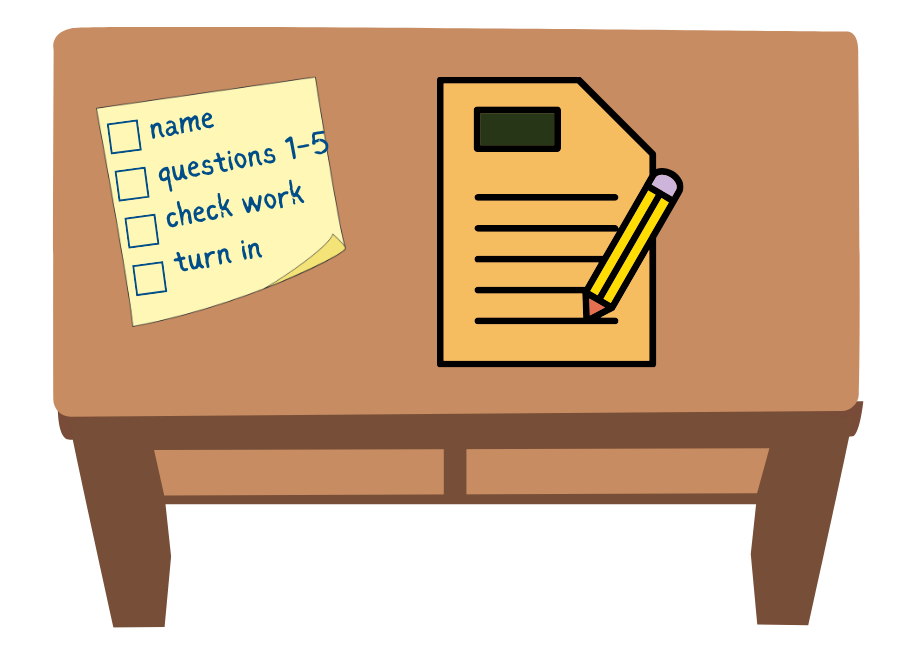
Instead of five verbal steps at once, give the first step and then check back. - Provide a mini checklist
Even a sticky note:
- Chunk larger assignments
Physically mark stopping points: Do 1–5. Check in with me. Then continue. - Give a two-minute warning before transitions
“Two minutes until we clean up and move to math.” - Identify the first step
For a student staring at a worksheet, simply say: “Start by writing your name. Then circle #1.”
Communication Accommodations
Communication accommodations can give students more time and different ways to process information, understand directions, and express what they know.
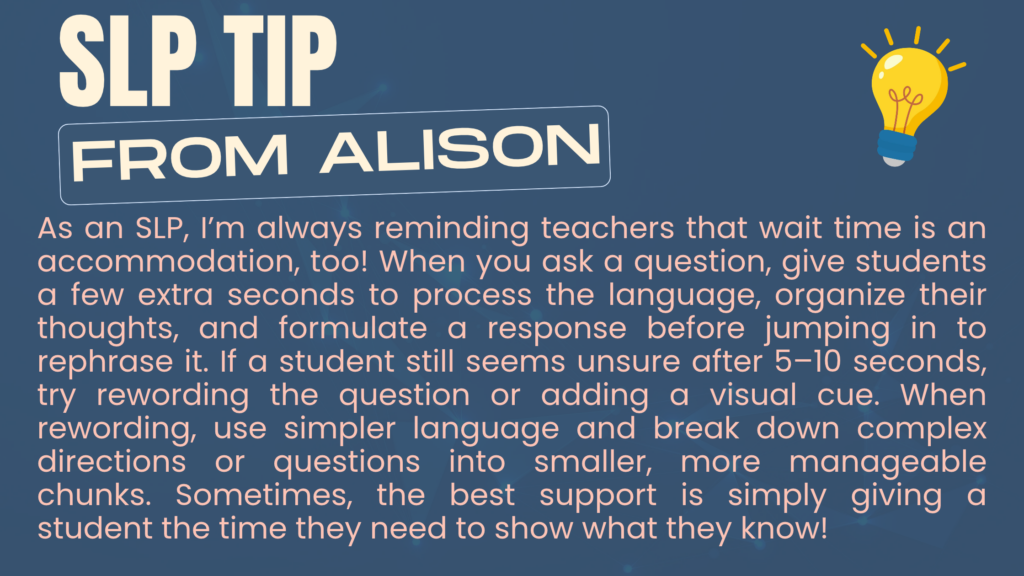
- Give extra processing time
Ask the question—and actually wait. - Pair verbal directions with visuals
Write the page number, assignment, or steps on the board while saying them. - Check for understanding privately
Instead of “Does everyone understand?” quietly ask the student to tell you what they’re going to do first. - Offer approved response choices when appropriate
- When the skill being assessed allows it, give students an appropriate way to respond, such as answering aloud or writing it down.
- Rephrase instead of simply repeating
If the student doesn’t understand the first time, say it differently rather than saying the exact same words louder or slower.
Accommodation ≠ Modification
These might seem similar, but they are not.
Accommodation: Changes how a student accesses learning or demonstrates knowledge.
Modification: Changes what the student is expected to learn or demonstrate.
For example:
Accommodation: Student listens to the grade-level passage using text-to-speech or an audiobook.
Modification: Student is given a different passage with substantially simplified content/expectations.
An accommodation removes a barrier. It doesn’t automatically make the work easier.
Twenty-five classroom accommodations might look like a lot on paper, but look back through this list. Most aren’t complicated. You’re giving a direction differently. Highlighting a section of a page. Providing a checklist. Waiting a few extra seconds. Identifying the first step.
Small changes can remove big barriers for students—and they don’t have to add hours to your workload.
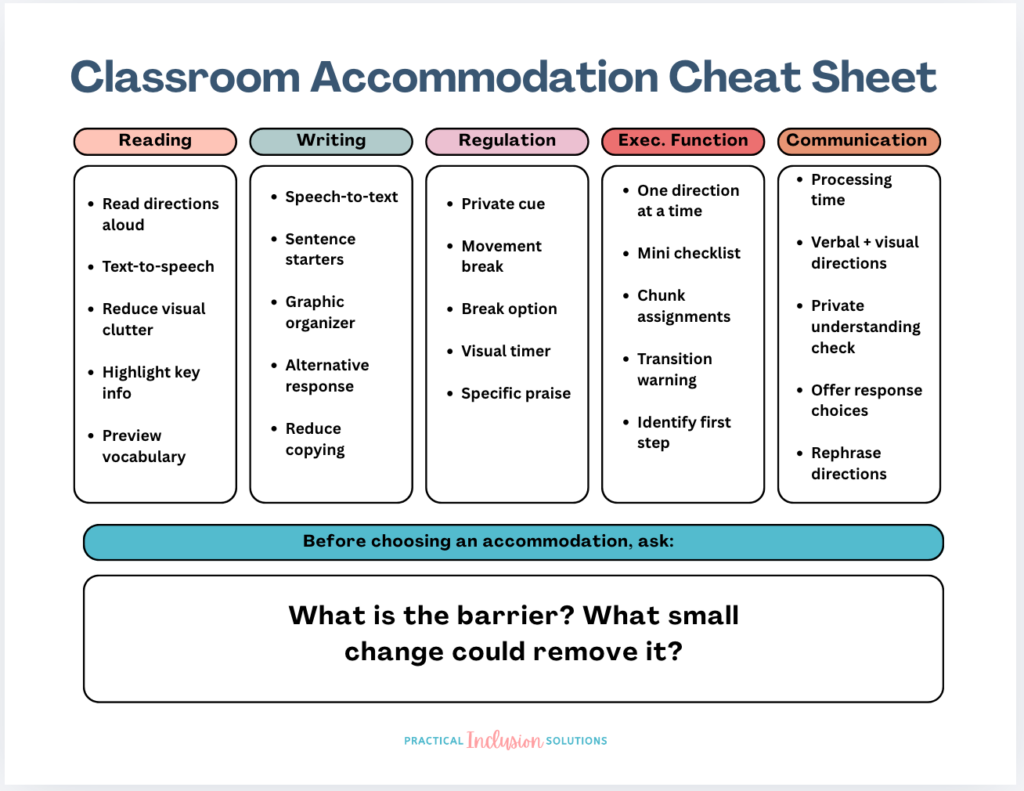
Want to keep these ideas at your fingertips? Grab our free Classroom Accommodation Cheat Sheet. It’s a one-page reference with all 25 strategies, perfect for keeping beside you while lesson planning.