Think about this scenario:
It’s a brand new school year. You open your class list and notice several of your students have IEPs. Suddenly you have so many questions…
- “What am I supposed to do?”
- “Do I have to memorize every page?”
- “Who do I ask for help?”
- “What happens if I miss something important?”
- “How do I keep up with it all?”
If you’re feeling overwhelmed, you’re not alone. Every school year, thousands of general education teachers welcome students with IEPs into their classrooms—and many of them have the exact same questions. The good news? You don’t have to become a special education expert overnight. You just need a clear place to start.
In this guide, I’ll walk you through exactly what to focus on during those first few weeks so you can move from feeling overwhelmed to feeling confident supporting every learner in your classroom.
First Week Priorities (Don’t Try to Do Everything)
When you see an IEP on your student roster, you might be tempted to read it cover to cover. Don’t do that! You may have multiple IEPs, and you will immediately feel overwhelmed. While every section is important, not every page requires your immediate attention during the first week of school.
Instead, focus on:
- Learning student names
- Building relationships
- Identifying safety or medical concerns
- Finding the required accommodations
- Introducing yourself to the special educator
Once you’ve taken care of these priorities, you can go back and explore the rest of the IEP in more detail.
💡Quick Tip: Remember: Your goal isn’t perfection during week one. Your goal is to make sure every student has access to learning from Day One.
How to Read an IEP Efficiently for Students with IEPs
You’re a busy teacher. You don’t need to become an expert in special education law before the first day of school. You need to understand the different parts of an IEP and what to know first.
Start here:
| Present Levels | What is the student currently doing? |
| Strengths | What is the student good at? |
| Goals | What did the Team select for the student to work on this year and how will they be working on it? |
| Accommodations | What can you do to help the student access their learning environment and curriculum? Do they need visual or auditory presentations? Do they need assistive technology or priority seating? Do they need extra time or frequent breaks? |
| Modifications | What needs to be changed so that the student can access the curriculum? Is it shorter texts, a different reading level, a simplified curriculum, less work, or alternative assignments? |
| Behavior Plans | Does the student need support in the area of behavior? And if so, what is the plan that you will follow to support them? |
| Service Minutes | You probably won’t be responsible for delivering most of these services. However, scanning this section helps you understand what support your student receives throughout the school day and who is working with them. |
💡Quick Tip: Don’t read an IEP like a novel. Read it like a reference manual.
The Four Things You Should Know About Every Student
You will have a lot of students in your class this year. They will all have different needs and personalities. It will take a while to get to know all of your students (see our last post for ideas on how to do this!). However, right off the bat, there are four things you should know about EVERY student.
- What helps this student learn?
- What barriers might they experience?
- What accommodations do I need to provide?
- Who should I contact if I have questions?
If you can answer these four questions, you’ve already built a strong foundation. Everything else can be learned over time with the support of your special education team.
Questions to Ask Your Special Education Teacher
Your special education teacher is one of your greatest resources. While the IEP provides important information, it doesn’t always capture the day-to-day strategies that make a student successful. A quick conversation can save you hours of trial and error.
Some helpful questions to ask are:
- What accommodations make the biggest difference?
- What has worked well in previous classrooms?
- Are there behavior supports I should know?
- How should we communicate throughout the year?
- Are there upcoming meetings or changes I should know about?
- What should I watch for during the first month?
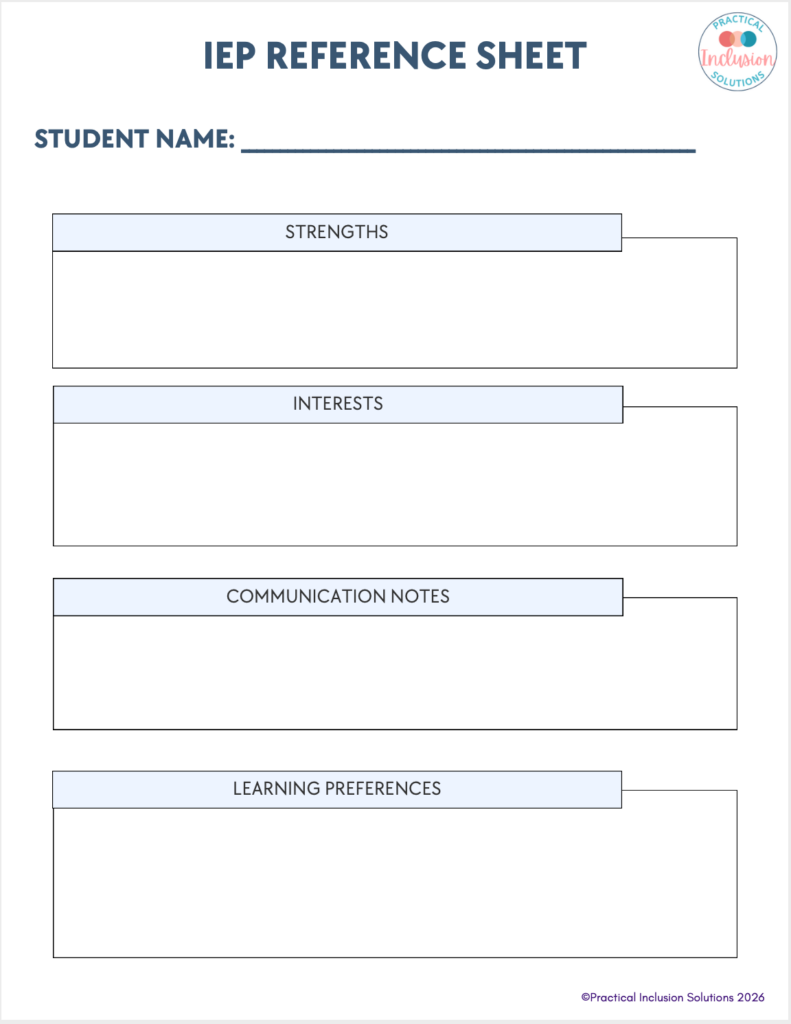
Some of the best general education teachers I know have an “IEP Snapshot” sheet that lists all of this information. Then, it can easily be referred back to rather than digging up and combing through the full IEP.
💡Quick Tip: Check in with the student’s general education teacher from last year to get practical, boots-on-the-ground strategies and firsthand information.
💡Quick Tip 2: If your district allows the use of AI tools, never upload confidential student information into a public AI platform. Instead, remove names and identifying information first, or summarize the relevant accommodations yourself before asking AI to help organize them into a quick-reference guide. This is a great way to use a tool to work smarter, not harder!
The Biggest Mistakes New General Education Teachers Make
Every teacher wants to do what’s best for their students. But when you’re juggling lesson planning, classroom management, meetings, and everything else on your plate, it’s easy to make inclusion feel harder than it has to be. Here are four common mistakes—and what to do instead.
🙅♀️ Mistake 1: Trying to memorize the entire IEP.
✅ Instead: Use it as a working document. You can’t hold dozens of IEP details in your head while simultaneously teaching lessons, managing behavior, answering questions, and keeping an entire classroom running. Do you see what I’m saying? We can’t do it all so don’t expect yourself to! Set yourself up for success by pinpointing the most important information and creating a brief reference document.
🙅♀️ Mistake 2: Waiting until there is a problem before talking with special education staff.
✅ Instead: Seek them out, even before the first day of school, they will be able to give you firsthand knowledge that you otherwise would have to scour the IEP to discover. They will be your best resource and making a point to proactively approach them and build a relationship right from the start will only help your students in the long run.
🙅♀️ Mistake 3: Assuming accommodations lower expectations.
✅ Instead: Think about equity rather than equality. What will help level the playing field for your students. Just because a student gets extra time to finish their test doesn’t mean they don’t know the information. Your expectation is just as high for the student at a standing desk as it is for the student in a regular desk and chair with four legs on the ground. A student listening to an audiobook is still taking in the same information, just in a different way. Accommodations are in place to help all students succeed and should be embraced.
🙅♀️ Mistake 4: Trying to do everything alone.
✅ Instead: Lean into your support system. Find ways to divide the work and share strategies between your colleagues. Get insider information from your special education teacher. Build a relationship with your principal so you feel comfortable approaching them when you are struggling. Lean into the paraprofessionals in your classroom to help out. Teaching may seem like a solo venture in your classroom but the more support you have, the more successful you will be. Inclusion works best when it’s a team effort – not a one-person job.
Your First Month Action Plan for Students with IEPs
Here’s what you’ve been waiting for. I know you’re secretly saying “this is all well and good, but HOW do I do all of this??” We’ve got you! Follow this four-week action plan to get situated at the beginning of the year.
Week 1
✔ Read accommodations
✔ Meet your special educator
✔ Learn student strengths
✔ Begin building relationships
Week 2
✔ Try accommodations consistently
✔ Observe what works
✔ Keep notes
Week 3
✔ Meet with specialists
✔ Adjust supports
✔ Ask follow-up questions
Week 4
✔ Reflect
✔ Celebrate progress
✔ Revise what isn’t working
You Don’t Have to Know Everything
Let me let you in on a little secret. The best teachers aren’t the ones who know every answer. They’re the ones who stay curious, ask questions, and build strong partnerships with students, families, and colleagues.
Remember, inclusion isn’t about having all the answers on day one. It’s about being willing to learn, ask questions, and keep your students at the center of every decision you make. One conversation, one accommodation, and one relationship at a time, you’ll build an inclusive classroom where every student has the opportunity to succeed.
Ready to make your IEPs easier to manage?
Download our free IEP Quick Reference Printable to quickly organize the most important information for each student. Instead of flipping through dozens of pages, you’ll have the accommodations, supports, strengths, and key contacts you need at your fingertips—all in one place.
Grab your free copy here!
One Reply to “I Have Students with IEPs…Now What? A General Education Teacher’s Survival Guide”