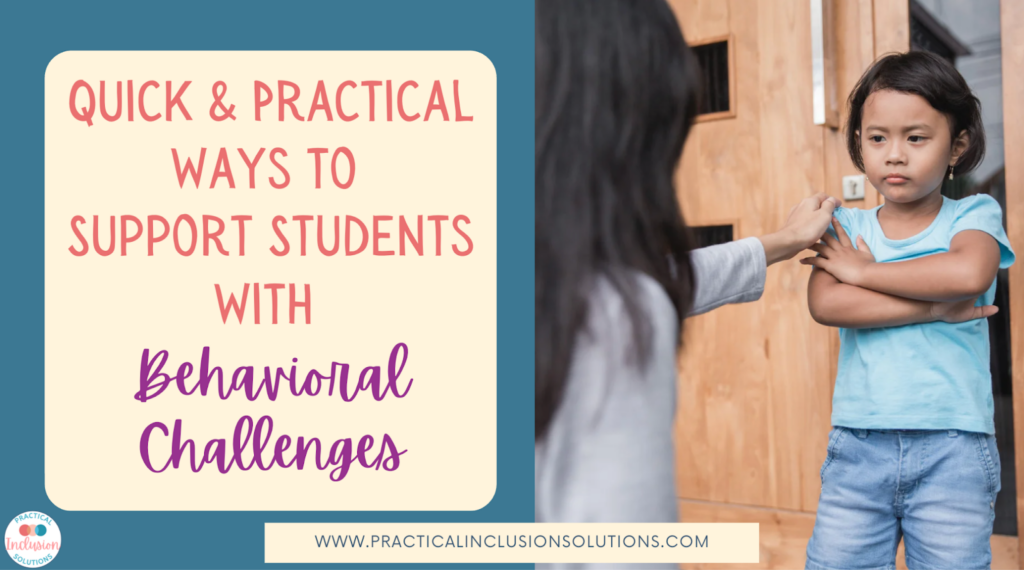
Supporting students with behavioral challenges can feel overwhelming—especially when you’re juggling academic demands, IEPs, and the everyday reality of a busy classroom. The good news? Small, intentional supports can make a big difference.
If you’re looking for additional strategies, our post on reviewing and revitalizing classroom routines offers mid-year refresh ideas, and our guide on maintaining student motivation in the classroom shares practical ways to help students stay focused and engaged.
This post focuses on quick, realistic strategies you can start using tomorrow—no fancy materials, no complete classroom overhaul required.
1. Behavior Is Communication (Always)
Before addressing the behavior, pause and ask:
- What is this student trying to communicate?
- What skill might be missing right now?
Many behaviors stem from unmet needs: difficulty regulating emotions, processing language, understanding expectations, or coping with sensory input. When we shift from “How do I stop this?” to “How do I support this?” we create space for real change.
Quick try: Mentally reframe challenging behavior as a signal, not a disruption.
2. Make Expectations Visible (Not Just Verbal)
Students with behavioral challenges often struggle with abstract or fast-paced verbal directions.
Easy supports:
- Post clear visual expectations (rules, routines, steps)
- Use first–then language (“First math, then choice”)
- Preview transitions before they happen
Why it works: Predictability reduces anxiety—and less anxiety often means fewer behaviors.
3. Pre-Correct Before Problems Start
Instead of waiting for a behavior to appear, proactively remind students what success looks like.
Example:
“Remember, when we work in groups, we use calm voices and keep hands to ourselves.”
This is especially powerful before:
- Transitions
- Group work
- Less structured activities
Quick win: One calm reminder can prevent a full disruption later.
4. Offer Choices (Without Giving Up Control)
Choice builds buy-in and helps students feel a sense of control—without changing the expectation.
Simple choices:
- “Do you want to start with #1 or #2?”
- “Do you want to sit here or there?”
- “Do you want to write or type?”
Key tip: All choices should still lead to the same learning goal.
5. Teach Regulation Skills Explicitly
Students aren’t born knowing how to calm their bodies—they need to be taught.
Quick regulation tools:
- Calm-down corner or break space
- Visual breathing cards
- Movement breaks built into the day
- Rating scales (“How big is the problem?”)
Important reminder: Regulation tools work best when taught outside of crisis moments.
6. Reinforce Effort, Not Just Compliance
Behavioral support isn’t about perfection—it’s about progress.
What to notice:
- Trying again after a mistake
- Using a strategy instead of melting down
- Asking for help appropriately
Example praise:
“I noticed you took a deep breath before asking for help—that was a great choice.”
Specific feedback helps students learn what they did right.
7. Keep Language Calm, Clear, and Neutral
When emotions rise, language matters.
Try this:
- Fewer words
- Calm tone
- Neutral facial expression
Instead of:
“How many times do I have to tell you?”
Try:
“Right now, the expectation is quiet work.”
This reduces power struggles and helps students reset faster.
8. Collaborate (You Don’t Have to Do This Alone)
Behavior support works best as a team effort.
Lean on:
- Special education teachers
- SLPs, OTs, counselors
- Behavior specialists
- Families
Share what’s working, what’s not, and what the student responds to best. Consistency across settings matters.
🗣️ SLP Perspective: Why Language Matters in Behavior
As speech-language pathologists, we often see behavior challenges tied directly to language breakdowns—not defiance.
Students may struggle to:
- Understand multi-step directions
- Process fast-paced verbal language
- Find the words to express frustration, needs, or emotions
When language demands exceed a student’s skills, behavior can become their most effective form of communication.
What helps most:
- Simplifying language
- Pairing verbal directions with visuals
- Modeling functional phrases (e.g., “I need help,” “Can I take a break?”)
Supporting communication skills doesn’t just improve behavior—it increases independence, confidence, and access to learning.
Behavior: Bringing It All Together
Supporting students with behavioral challenges doesn’t require perfection—or endless new systems. It requires intentional, inclusive practices that prioritize predictability, connection, and skill-building.
Start small. Pick one strategy. Try it consistently.
Because when we support behavior, we support learning—for everyone.
Looking for more practical inclusion strategies? Follow Practical Inclusion Solutions for tools, tips, and ideas you can actually use in your classroom.