By May, you’re tired. Your students are tired. And it’s easy to focus on what didn’t get done over the past year.
But let’s try a mindset shift.
Because this is actually one of the best times to:
- Reflect on growth
- Strengthen relationships
- Reinforce your classroom inclusion values
When many of us think of celebrations, we think of the end of something or a big milestone. But celebrations don’t have to wait for a finish line.
Celebration isn’t about perfection or completion—it’s about recognizing progress, connection, and belonging.
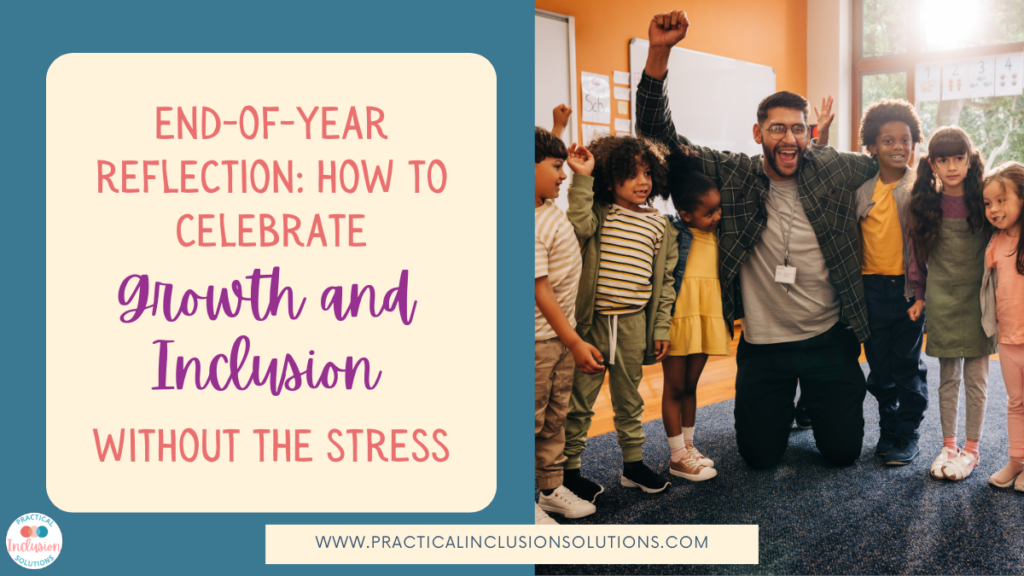
Redefining “Achievement” in an Inclusive Classroom
Not all growth shows up on a test.
(And honestly? I was a terrible test taker when I was in school. The stress and anxiety would hit, and everything I studied would disappear.)
As inclusive educators, we have the opportunity to highlight all kinds of growth.
Yes—academic growth matters. But it’s only one piece of the picture.
Students also grow in:
- Social-emotional skills
- Behavior and self-regulation
- Communication
- Independence
- Confidence
- Relationship-building
Here are a few examples worth celebrating:
- A student asking for help instead of shutting down
- A student participating in group work for the first time
- A student using coping strategies independently
All of these are worth a celebration in my book.
Bottom line: Growth looks different for every student—and all of it deserves to be recognized.
Celebrating Relationships and Classroom Community
Your classroom isn’t just a group of individuals—it’s a community you built.
As you reflect on the year, think about moments like:
- Friendships that formed
- Students supporting one another
- Increased empathy
- Collaborative learning wins
Also, think about the routines you put in place to support inclusion.
Take a second and let that sink in.
Then give yourself a pat on the back—and maybe even a little happy dance.
You built that.
Why Celebration Supports Inclusion
At this point in the year, it’s fair to ask:
Why add one more thing when everyone is already exhausted?
Because celebration isn’t “one more thing”—it’s something that amplifies everything else you’ve done.
Celebrating growth helps:
- Build student confidence
- Reinforce a growth mindset
- Help every student feel seen and valued
- Strengthen classroom belonging
- End the year on a positive, relationship-centered note
Celebrations aren’t extra – they’re part of effective, inclusive teaching and a meaningful way to celebrate growth and inclusivity in your classroom.
Think about how it feels when a colleague recognizes your work.
Now multiply that feeling by every student in your classroom.
(And honestly – why not celebrate a coworker while you’re at it, too?)
Practical, Low-Stress Ways to Celebrate Growth and Inclusivity
We’ve talked about the why – now let’s get into the how.
Here are a few low-effort, high-impact ways to celebrate your students:
- “Glow & Grow” reflection sheets
- Personalized student notes
- Class compliment circle
- Non-academic awards (effort, kindness, perseverance)
- Before/after reflections (“What I couldn’t do → What I can do now”)
- Memory wall or slideshow
And here’s the key reminder:
These don’t need to be time-consuming or Pinterest-perfect.
At the end of the day, ask yourself:
Did my students feel recognized and celebrated?
If the answer is yes, you did it right.
Don’t Forget One Important Person…
There’s one more person who deserves to be celebrated.
You.
Take a moment to look back on this year:
- The adjustments you made
- The challenges you navigated
- The ways you made your classroom more inclusive
You did more than teach content.
You created a space where students belonged.
That matters.
So yes – celebrate yourself too.
Whether that looks like an adult beverage, a quiet moment, or a much-needed pedicure… you’ve earned it.
Taking time to celebrate growth and inclusivity helps students – and teachers – end the year feeling proud, connected, and valued.
Final Reflection
Before the year ends, ask yourself:
“What is one moment from this year that reminded me why inclusion matters?”
Hold onto that moment.
And then go celebrate the heck out of it.