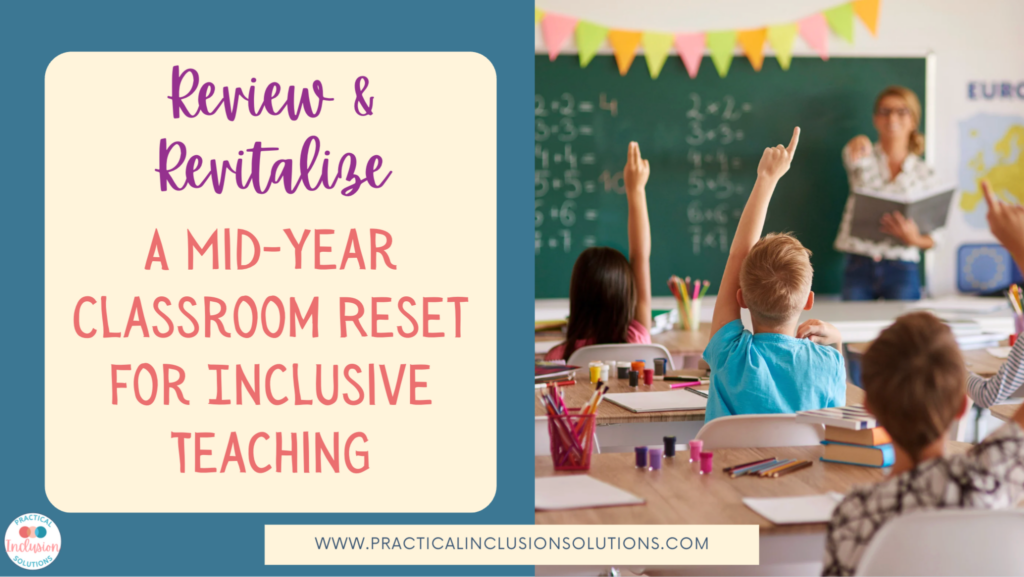
The return from winter break offers a natural pause point—a chance to look closely at what’s working, what needs adjusting, and how we can intentionally strengthen inclusion in our classrooms. Students walk in with fresh energy (and sometimes a few wobbles), making it the perfect time to revisit routines, refresh instructional approaches, and set the tone for a supportive, accessible learning environment. If you’re looking for a deeper dive into building access for all learners, our posts on understanding diverse learning styles, strategies for differentiated instruction, and strengthening collaboration between general and special education teachers pair well with this mid-year reset.
Below are practical, meaningful, and realistic ways to review and revitalize your classroom with inclusion in mind.
1. Revisit Classroom Routines & Expectations (With Student Voice!)
January is a perfect moment to reset expectations—without starting from scratch.
- Re-teach routines explicitly, even if students “should already know.” Many learners with executive functioning or language needs benefit from clear modeling and practice.
- Invite student reflection. Ask: What’s working? What feels confusing? What makes our classroom feel safe and supportive?
This empowers students with IEPs or diverse learning needs to advocate for clarity in routines. - Adapt routines if certain transitions, materials, or group processes consistently cause breakdowns.
Inclusion tip:
Provide visual supports, simplified checklists, or video models of routines to support diverse learners and multilingual students.
2. Refresh Your Learning Environment
A few intentional updates can make a big difference in access.
- Declutter high-traffic areas to reduce sensory overload and improve mobility.
- Label or re-label classroom materials using both text and visuals.
- Create or update “help yourself” stations—graphic organizers, vocabulary cards, sentence starters, fidgets, timers, highlighters.
- Adjust your seating chart to support peer relationships, minimize distractions, or strengthen small-group learning.
Inclusion tip:
Check for “hidden barriers”—are supplies reachable? Are instructions displayed visually and verbally? Are anchor charts current and easy to see?
3. Audit Your Group Work & Collaboration Structures
Group work is powerful—but only when everyone can meaningfully participate.
Try reviewing your current structures:
- Are roles clear and accessible (e.g., “reader,” “checker,” “materials manager”)?
- Do students know how to ask for help from peers?
- Is there a plan for students who struggle with social communication or initiation?
Revitalize your approach:
- Introduce role cards with icons/visual cues.
- Use sentence stems to support peer communication (“I notice…”, “Can you explain…?”, “Let’s try…”).
- Model what successful collaboration looks like—and what it doesn’t.
Inclusion tip:
Pair or group students intentionally based on strengths, not just levels. Some students shine when given leadership or organizational roles that match their abilities.
4. Review Instructional Strategies Through an Inclusion Lens
Midyear is an ideal time to reflect on your teaching practices.
Ask yourself:
- Are lessons accessible to visual, auditory, and kinesthetic learners?
- Do students have multiple ways to show what they know?
- Are accommodations being used proactively—not just during testing?
Consider adding:
- Choice boards or menus to increase autonomy.
- Multi-sensory practice routines for vocabulary, writing, or math.
- Previewing and pre-teaching for students who need background knowledge to participate fully.
- “Wait time plus”—build in pauses, repeat instructions, or check for understanding with simple chips/cards.
Inclusion tip:
Invite your speech-language pathologist, special education teacher, or learning specialist to co-plan one or two lessons this month. Fresh eyes lead to new ideas!
5. Reconnect with IEPs, Behavior Plans, and Student Profiles
January is a great time to pull recent data and re-read supports.
- Revisit goals and accommodations. Are they being implemented consistently?
- Look at student progress—are current strategies effective, or does something need to shift?
- Check in with students: “What helps you learn best?”
Inclusion tip:
Create a simple one-page “At-A-Glance” for each student with quick reminders about strengths, needs, and accommodations. Update it for spring.
6. Boost Classroom Community and Belonging
After a long break, connections matter.
Try refreshing community-building routines:
- A weekly recognition system (like Effort Tickets!).
- Morning meeting prompts that build empathy and celebrate strengths.
- Peer shout-outs or “kindness chains.”
- Collaborative goal-setting for the whole class.
Inclusion tip:
Celebrate different types of progress—not just academic achievement. Include bravery, persistence, creativity, and kindness.
7. Choose One “Revitalize Goal” for Yourself
Teachers don’t need to overhaul everything. Pick one target area:
- “I will strengthen visual supports.”
- “I will redesign group roles for more inclusive collaboration.”
- “I will check in weekly with my co-teacher/Special Ed partner.”
- “I will incorporate more universal design into writing tasks.”
Write it down, post it near your desk, and revisit it monthly.
Final Thoughts
The new year is more than a restart—it’s a chance to intentionally build a classroom where every student feels supported, valued, and capable. Small shifts can create big changes, and by reviewing and revitalizing your routines, space, and strategies, you set the stage for a strong, inclusive second half of the school year.